How to Trade the London Session
7 min read · Updated Sep 11, 2026
Short answer
The London session runs 08:00–17:00 UTC in winter (07:00–16:00 UTC on British Summer Time) and is the busiest of the three, with the United Kingdom accounting for the largest single share of global forex turnover. Most of the day's range is built in the first two hours, when London frequently sweeps the liquidity sitting above or below the Asian range before committing to a direction.
The London session covers 08:00–17:00 UTC in winter (07:00–16:00 UTC on summer time) and is the centre of gravity of the forex trading day. The United Kingdom handles the largest single share of global FX turnover — roughly 38% in the Bank for International Settlements triennial survey — which means the deepest order flow of the twenty-four hours passes through these nine hours.
The practical consequence is that London usually produces the day's high or the day's low, and often both. Whatever range the Asia session built overnight tends to be broken, extended or reversed here.
When London runs, and why the overlaps matter
London is the only session that overlaps with both of the others. It shares its first hour with a closing Asia, and its final four hours with a freshly opened New York. Those overlap windows are where liquidity is deepest and where the largest moves cluster.
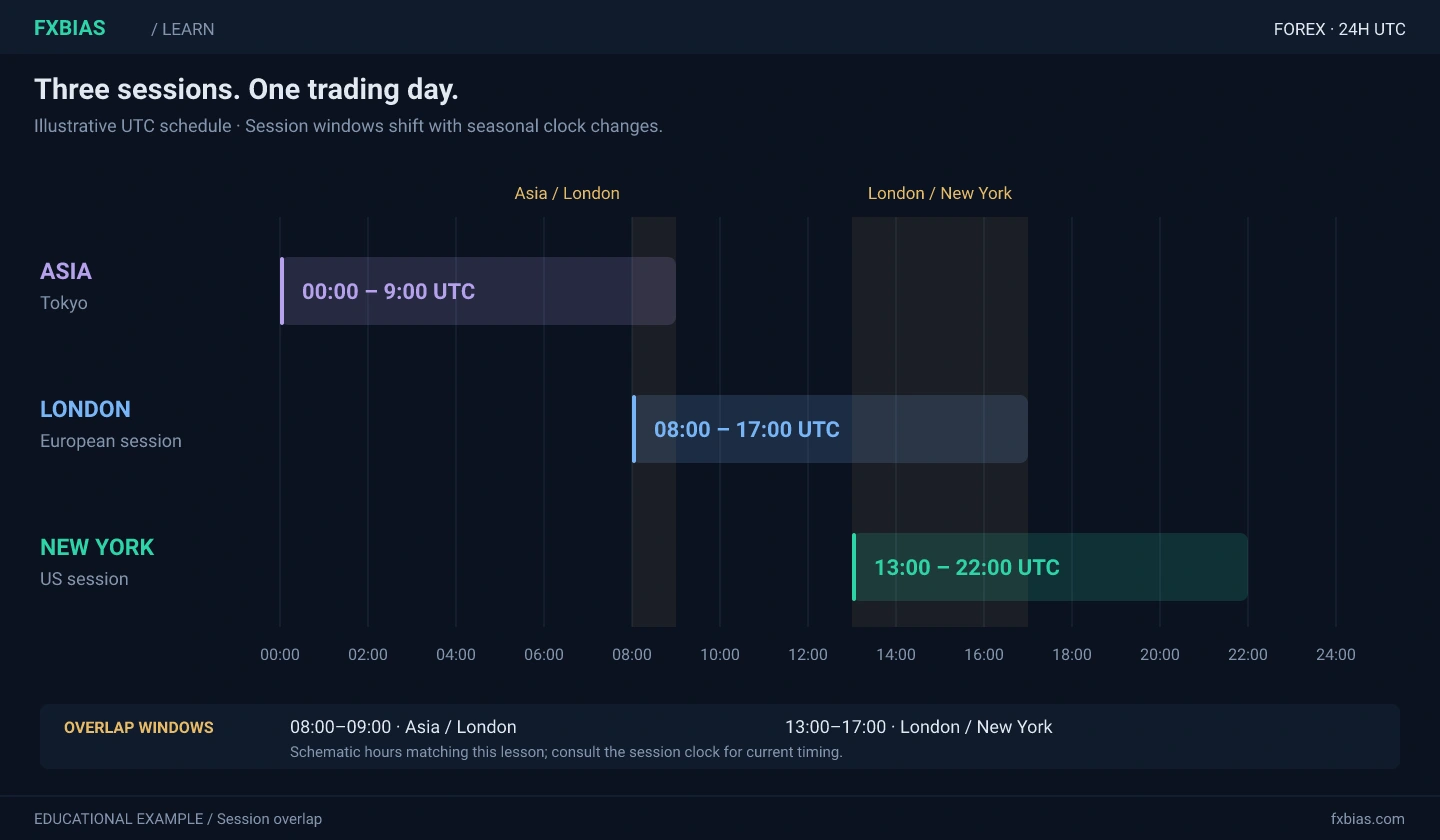
One caveat on the clock: those are the winter UTC windows. London and New York shift an hour earlier in UTC while on summer time — so from late March to late October the London session runs 07:00–16:00 UTC. Asia does not move at all, because Japan has no daylight saving. The two western centres also change their clocks on different dates, so for a few weeks each spring and autumn the overlap runs an hour longer or shorter.
Why the first two hours matter most
European desks arrive to a book of orders accumulated overnight and position for the day in a short window. Add the European data calendar — UK figures an hour before the open, German and eurozone releases around it, and ECB or Bank of England communication — and the first two hours routinely contain a large share of the entire day's range.
This cuts both ways. It is the window with the most opportunity and the one where a poorly placed stop is most likely to be taken out by noise rather than by a genuine change in direction.
The opening sweep
The most discussed London pattern goes by several names — the opening sweep, the Judas swing, the stop run. The sequence is consistent:
- Asia leaves a narrow range overnight, with stop orders clustered just beyond its high and low.
- London opens and drives through one of those extremes, filling the orders resting there.
- Price fails to hold beyond the level, closes back inside the range, and then trends in the opposite direction.
The logic is the same one behind any liquidity sweep: large participants need counterparties to fill against, and the obvious pools of resting orders are the ones sitting at yesterday's and last night's extremes. Sweeping them is not a conspiracy, it is where the available liquidity happens to be.
The important qualifier is that it does not always happen. On strong trend days London opens and simply runs, with no sweep at all. Treating the pattern as a rule rather than a tendency means fading genuine breakouts.
Reading the open without predicting it
Rather than guessing which side gets swept, most approaches wait for the market to reveal it. The common sequence is to mark the Asian high and low before the open, let the first 30–60 minutes trade, and only then look for a change of character on a lower timeframe — a swing point broken against the direction of the opening push. That break is what distinguishes a sweep that has completed from one still in progress.
Entries are then usually sought on a pullback into whatever the reversal left behind: an unfilled Fair Value Gap or the order block at the origin of the move.
The 17:00 close
London's close is a real event rather than an arbitrary line. European desks square positions into it, and the withdrawal of that liquidity often stalls or partially retraces whatever ran during the afternoon. Trades held from the London morning into the evening are exposed to a market with materially fewer participants than the one they were opened in.
Common mistakes
- Trading the first candle. The 08:00 print is frequently the least informative of the session. Letting the opening range establish itself costs a few minutes and removes most of the guesswork.
- Assuming the sweep is guaranteed. It is a tendency, not a rule, and fading a real breakout because you expected a reversal is an expensive way to learn the difference.
- Using Asia-sized stops. London ranges are several times wider. A stop that was sensible overnight is noise-sized after the open.
- Ignoring the calendar. An ECB decision or a UK inflation print will override any technical read. Check what is scheduled before the open, not after.
Frequently asked
What time is the London forex session?
08:00–17:00 UTC, matching an 8am–5pm working day in London during the winter months. From late March to late October the UK moves to British Summer Time (UTC+1), so the same local working day falls one hour earlier in UTC terms. If you set alerts in your own local time, check them again after each clock change.
Why is London the most volatile forex session?
Three things stack up at once. London is the largest FX dealing centre in the world — around 38% of global turnover in the BIS triennial survey — so the deepest order flow passes through it. European macro data is released in the hours around the open. And for its first hour London overlaps with a still-open Asia, which means two regions are pricing the same instruments simultaneously.
What is the London opening sweep, or Judas swing?
A move in the first 30–90 minutes of London that pushes through the Asian range high or low, triggers the stops resting there, and then reverses and trends the other way for the rest of the session. The nickname comes from the idea of a false lead: the first direction betrays anyone who chases it.
Which pairs are most active during the London session?
Anything with EUR, GBP or CHF in it — EURUSD, GBPUSD, EURGBP, EURJPY and GBPJPY are the usual choices, and gold is also heavily traded during European hours. These instruments see their widest spreads-to-range ratio in London's favour, meaning the range is large relative to the cost of trading it.
Continue reading
Apply this with FXBias daily briefings
Start Free