How to Build a Daily Forex Bias
6 min read · Updated May 23, 2026
Short answer
A daily bias is built top-down: read the higher timeframe trend (daily and 4-hour structure), mark the liquidity pools price is likely to target, locate unfilled imbalances that could act as support or resistance, then check the economic calendar for catalysts. The bias is bullish, bearish or neutral — and neutral is a valid answer.
A daily bias is the directional opinion you bring into a trading session before you take any positions. It is the difference between disciplined trading and reactive gambling. With a bias, every setup is filtered: trades agreeing with it get taken, trades fighting it get skipped. Without one, every candle looks like a signal.
This is the five-step process FXBias uses to build a bias for each session on EURUSD, GBPUSD, USDJPY, XAUUSD and the other twelve pairs we cover.
Step 1: Higher timeframe structure
Open the daily and H4. Are we printing higher highs and higher lows (bullish), lower lows and lower highs (bearish), or stuck in a range? HTF structure is the anchor — every lower-timeframe decision should respect it. A bullish daily structure means we look for longs on retraces, not shorts on every wick.
Step 2: Where is the liquidity?
Mark the obvious pools:
- Previous day high / low
- Asia session high / low (for London bias)
- London session high / low (for NY bias)
- Equal highs / equal lows on H1 — these are stop-magnets
The bias usually points toward the next untapped liquidity pool in the direction of HTF structure. If the daily is bullish and there is a clean equal-highs on H1 above, that is the target.
Step 3: Has liquidity been taken already?
A recent liquidity sweep in the direction opposite to HTF bias is fuel for the bias direction. If daily is bullish and price just swept the previous day low, that is a strong bullish bias for the upcoming session — the sweep cleared shorts and gave institutions their long fills.
Step 4: Unfilled FVGs in your direction
Scan H4 and H1 for unfilled Fair Value Gaps. An unfilled bullish FVG below current price is a magnet — price often returns to it before continuing up. That gives you both an entry zone and a confirmation that buyers are still in control.
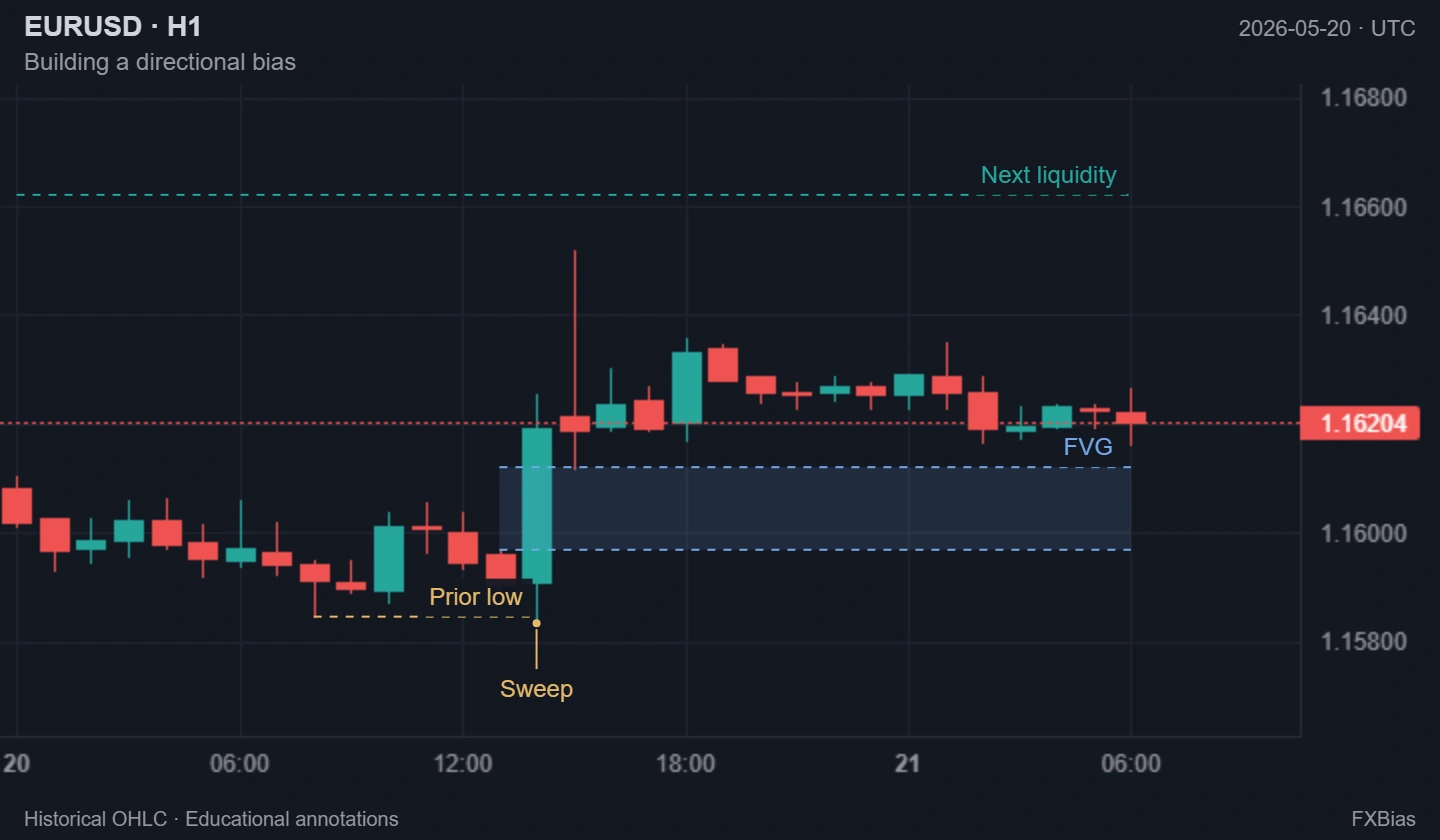 Historical exampleView full size ↗
TradingView Lightweight Charts™ © 2025 TradingView, Inc.
Step 5: News and session context
Check the economic calendar. High-impact news (NFP, FOMC, ECB, CPI) can invalidate any bias instantly. If a major print is due during your session, either size down or stay flat through the release. Each session also has its own personality — Asia is range-bound, London is directional, NY is news-driven.
Bias output
At the end of the process you should be able to write a single sentence:
"EURUSD bias is bullish for London. Daily structure is bullish, price swept yesterday's low at 1.0820, there is an unfilled H1 FVG at 1.0855 acting as a magnet, no high-impact USD news until 14:30 UTC."
That sentence tells you exactly what to look for, where to enter, and when to stand aside.
Get the bias done for you
Building a bias takes 15–20 minutes per pair per session. FXBias does it for fifteen pairs three times per day, runs it through an 11-point checklist, and ships the result before the session opens. Start free and follow up to five pairs.
Frequently asked
What is a daily bias in forex?
A directional opinion (bullish, bearish, or neutral) on a given pair for the current trading day. It is set before the session opens and guides which setups you take and which you skip.
Should I have the same bias on every pair?
No. USD-strong days can be bullish on USDJPY but bearish on EURUSD and XAUUSD. Bias is per pair, and correlated pairs usually share direction.
How often should I update my bias?
Once per session — before Asia, before London, before NY. Within a session, stick to the bias unless a clear Change of Character invalidates it.
Continue reading
Apply this with FXBias daily briefings
Start Free