What is a Liquidity Sweep in Forex?
6 min read · Updated May 23, 2026
Short answer
A liquidity sweep is a sharp move that pushes price beyond a prior high or low, triggers the stop-loss orders resting there, and then reverses. On a chart it appears as a wick that pierces the level and a close back inside the range. Institutions use these moves to source the counterparty volume needed to fill large positions.
A liquidity sweep is a sharp move that pushes price beyond a prior high or low, triggers the stop-loss orders resting there, and then reverses. Smart Money traders rely on these moves because they need counterparty volume to fill large positions — and the easiest place to find that volume is exactly where retail stops are clustered.
If you have ever placed a buy stop above resistance only to watch price spike through your entry and then collapse, you have been on the wrong side of a sweep. The good news is that the pattern is repeatable, mechanical, and one of the most useful tools for building a daily directional bias.
Why liquidity sweeps happen
Institutional desks cannot click a market order for fifty million euros without moving price against themselves. They need resting orders to absorb their fills. Stop-losses act as market orders — a long stop above the high becomes a sell market order the instant it triggers. By pushing price into those stops, the institution gets the counterparty it needs at a price it controls.
How to identify a sweep
- A wick that closes back inside the range after piercing the prior high or low.
- The level swept is meaningful: prior session H/L, daily H/L, or equal highs/lows.
- A shift in delta or volume appears at the extreme — buyers absorbing sellers (bullish sweep) or sellers absorbing buyers (bearish sweep).
- Within 1–3 candles, price reclaims the level and starts trading in the opposite direction.
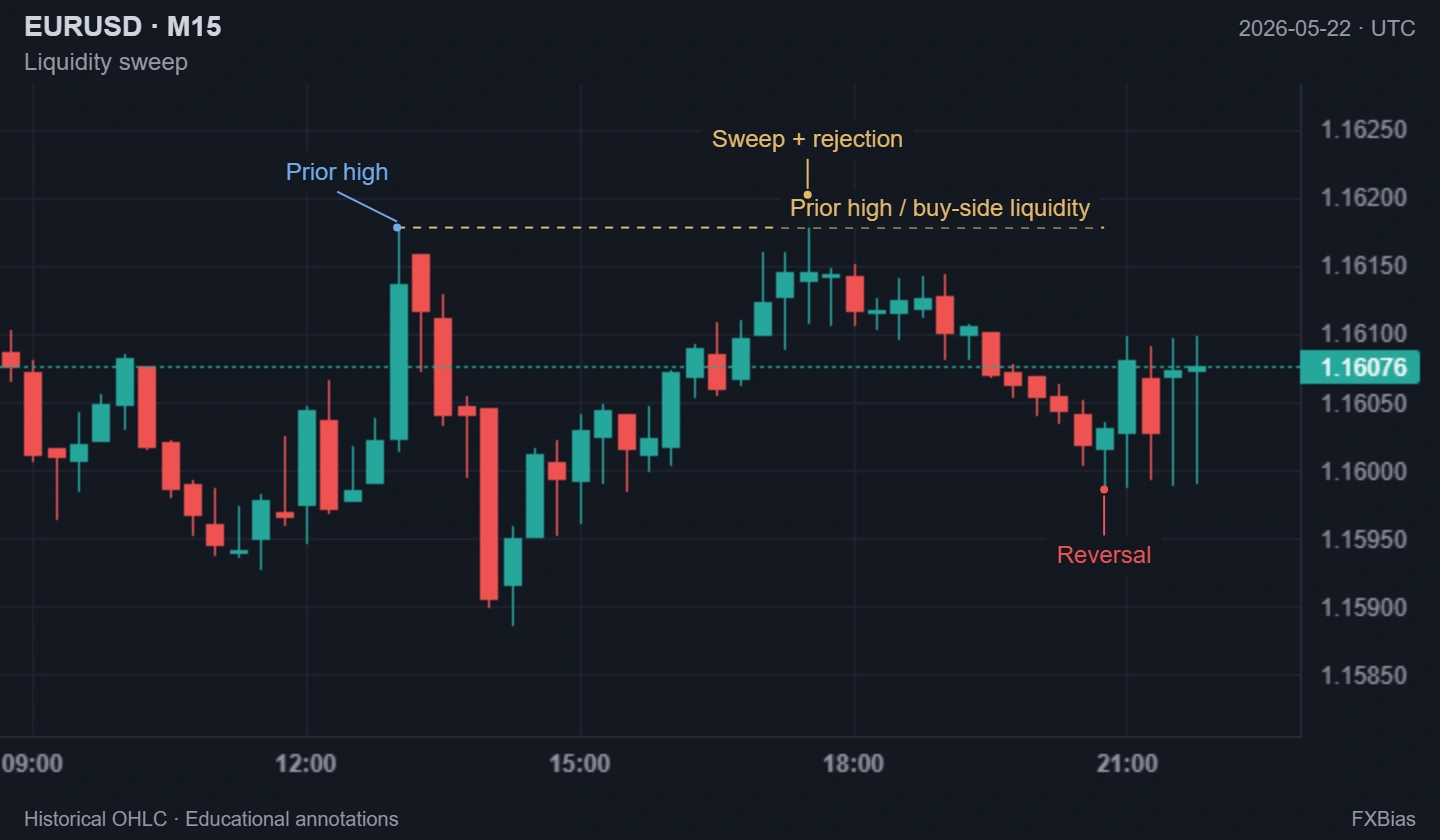 Historical exampleView full size ↗
TradingView Lightweight Charts™ © 2025 TradingView, Inc.
Classic examples
London open sweeps Asia range
The Asia session ( 00:00–09:00 UTC) typically produces a 30–50 pip range onEURUSD and GBPUSD. When London opens at 08:00 UTC, the first 30–60 minutes frequently take out either the Asia high or the Asia low — but not both. Whichever one gets swept first becomes the false breakout; the real London move runs in the opposite direction.
New York open sweeps London range
The same pattern plays out at 13:00 UTC. New York traders need liquidity, the London range provides obvious stop pools at the H/L, and the first hour of NY often produces a quick reversal sweep before settling into trend.
Those are the winter clock times. London and New York shift an hour earlier in UTC while on summer time, so from spring to autumn the same two sweeps land at 07:00 and 12:00 UTC. Asia does not move — Japan has no daylight saving.
Common mistakes
- Treating every wick as a sweep. A sweep only counts at a meaningful level.
- Entering on the wick itself. Wait for the reclaim — the candle that closes back inside the range — to confirm.
- Ignoring the daily bias. A bearish sweep against a strong bullish daily bias is usually just noise. Use sweeps that agree with higher-timeframe direction.
Where to go next
Liquidity sweeps rarely act alone. They pair beautifully with Fair Value Gaps: a sweep followed by an FVG-rejection entry is one of the highest-probability Smart Money setups on the chart. Together they form the core of the Smart Money Concepts framework.
Frequently asked
What does a liquidity sweep look like on a chart?
A wick that pierces a prior swing high or low and closes back inside the range. The body of the candle finishes below the high (for a bearish sweep) or above the low (for a bullish sweep), trapping breakout traders.
Is every wick a liquidity sweep?
No. A sweep only counts when the wick takes out a meaningful pool of stops — typically the previous session high/low, daily high/low, or a clear equal-highs/equal-lows pattern. Random wicks in the middle of the range are noise.
Which sessions produce the cleanest sweeps?
London open (08:00 UTC, 07:00 in summer) frequently sweeps the Asia range, and New York open (13:00 UTC, 12:00 in summer) often sweeps the London range. These are the highest-probability windows.
Continue reading
Apply this with FXBias daily briefings
Start Free