Fair Value Gaps (FVG) Explained
5 min read · Updated May 23, 2026
Short answer
A Fair Value Gap is a three-candle pattern where the middle candle moves so aggressively that its neighbours' wicks never overlap, leaving an untraded price zone. A bullish FVG forms when candle one's high sits below candle three's low. Price frequently returns to fill that imbalance before continuing, making FVGs useful entry and target zones.
A Fair Value Gap (FVG) — sometimes called an imbalance — is a three-candle pattern that signals inefficient price delivery. When price moves so aggressively in one direction that buyers and sellers never finish trading at a particular level, the market leaves a gap behind. These gaps tend to act as magnets: price often returns to fill them before continuing.
How to identify an FVG
Look at any three consecutive candles. The FVG is the empty space between:
- The high of candle 1 and the low of candle 3 (bullish FVG), or
- The low of candle 1 and the high of candle 3 (bearish FVG).
Candle 2 — the impulsive move — passes through the gap without trading there. That untraded zone is the imbalance. The cleaner the gap (the wider candle 2 is relative to candles 1 and 3), the more reliable the level.
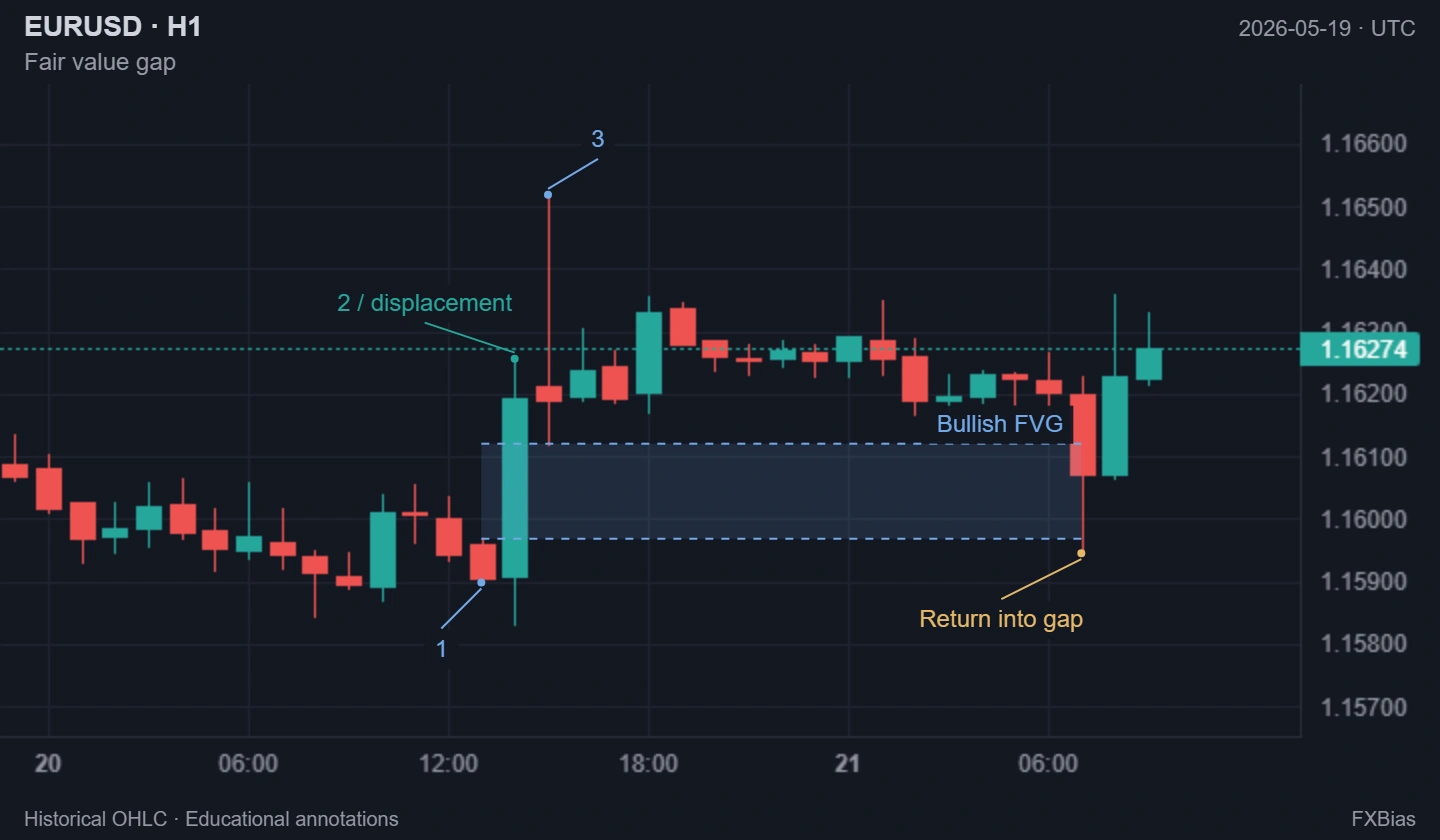 Historical exampleView full size ↗
TradingView Lightweight Charts™ © 2025 TradingView, Inc.
Why FVGs work
Markets seek efficient delivery. When price prints a sharp directional candle, there were not enough opposing orders to fill at intermediate levels. The market remembers these inefficiencies and frequently revisits them to "fill the gap" — giving patient liquidity providers their fills. That return move is your trading opportunity.
How to trade an FVG
1. Establish bias first
Do not trade FVGs in isolation. If your daily bias is bullish on EURUSD, look only for bullish FVGs as buy zones on lower timeframes. Bearish FVGs against your bias should be ignored or used only for exits.
2. Wait for the retest
Mark the FVG with a rectangle. Wait for price to return to it. The ideal entry is in the 50% of the gap (the consequent encroachment), but conservative traders wait for a full retrace and a confirmation candle.
3. Place stops beyond the next swing
Stop-loss goes below the swing low (bullish FVG) or above the swing high (bearish FVG) that created the gap. Target the next opposing FVG, an unswept liquidity pool, or a 2R take-profit.
FVG plus liquidity sweep — the A+ setup
The highest-probability Smart Money setup combines two ideas: a liquidity sweep against your bias direction, followed by an FVG forming in your bias direction. The sweep clears the stop pool; the FVG marks the institutional entry; price retraces into the FVG and continues. You enter on the retrace.
FVG on gold and JPY pairs
XAUUSD produces some of the cleanest FVGs because of its high volatility — H1 gold gaps are often 200–400 pips wide. JPY crosses like GBPJPY and USDJPY also leave large FVGs during news prints. Use a wider stop-loss accordingly.
Common mistakes
- Trading every FVG. Filter aggressively by daily bias.
- Front-running the fill. Wait for price to actually touch the gap.
- Ignoring breaker FVGs. An FVG that gets violated and reclaimed in the opposite direction becomes a breaker — and often a stronger level than the original.
Frequently asked
What is a Fair Value Gap?
A three-candle pattern where the wick of candle 1 and the wick of candle 3 do not overlap, leaving a gap inside candle 2. The gap represents inefficient price delivery and tends to get revisited.
Do FVGs always get filled?
No. Roughly 60–70% of FVGs get partially or fully revisited within a few sessions, but persistent trends can leave gaps unfilled for weeks. Always combine FVG with a directional bias.
What timeframe is best for FVG?
H1 and H4 produce the cleanest, highest-probability FVGs. M15 gaps are noisier but useful for entries. Daily FVGs act as major support/resistance.
Continue reading
Apply this with FXBias daily briefings
Start Free