How to Trade the Asia Session
5 min read · Updated May 23, 2026
Short answer
The Asia session runs 00:00–09:00 UTC and is typically the quietest of the three, producing a narrow consolidation range. Most traders use it in one of two ways: trading the range itself on AUD, NZD and JPY instruments where Asia is the home session, or marking the Asian high and low as the liquidity London is likely to sweep at the London open.
The Asia sessioncovers 00:00–09:00 UTC and is the quietest of the three major forex sessions. Daily range during Asia is typically 30–50% of the full day. Beginners often dismiss it as "boring" — but Asia is where the day's structure gets set, and trading the session well sets up the London open trade that follows.
What actually happens in Asia
With Tokyo, Sydney and Singapore as the active centres, the market is dominated by carry-trade flows, Japanese exporter hedging, and Australian/Chinese macro data. Major news during Asia is rare — but when it hits (BoJ statement, RBA decision, Chinese trade balance), Yen crosses and AUD pairs move sharply.
For non-Yen pairs like EURUSD and GBPUSD, Asia is mostly a slow grind inside a 20–40 pip range. That range is the data point — the high and low become the most important levels for the London session.
The Asia range strategy
The setup has three parts:
1. Mark the Asia range
One hour before London opens — 07:00 UTC in winter, 06:00 UTC while London is on summer time — draw a box from the highest high to the lowest low of the Asia session. These two levels are now stop pools: longs from the range high, shorts from the range low.
Every London and New York time in this article moves with them. Asia does not: Japan has no daylight saving, so the session sits at 00:00–09:00 UTC all year.
2. Wait for the sweep
The first 60–90 minutes of London typically sweep one side of the Asia range. Which side depends on daily bias — bullish bias usually means Asia low gets swept (clears shorts), then price runs up; bearish bias means Asia high gets swept first.
3. Enter on the reclaim
Do not enter on the sweep itself. Wait for the candle that closes back inside the Asia range. That is your trigger. Stop-loss goes just beyond the sweep extreme. Target the opposite side of the Asia range as TP1, and the next H1 imbalance as TP2.
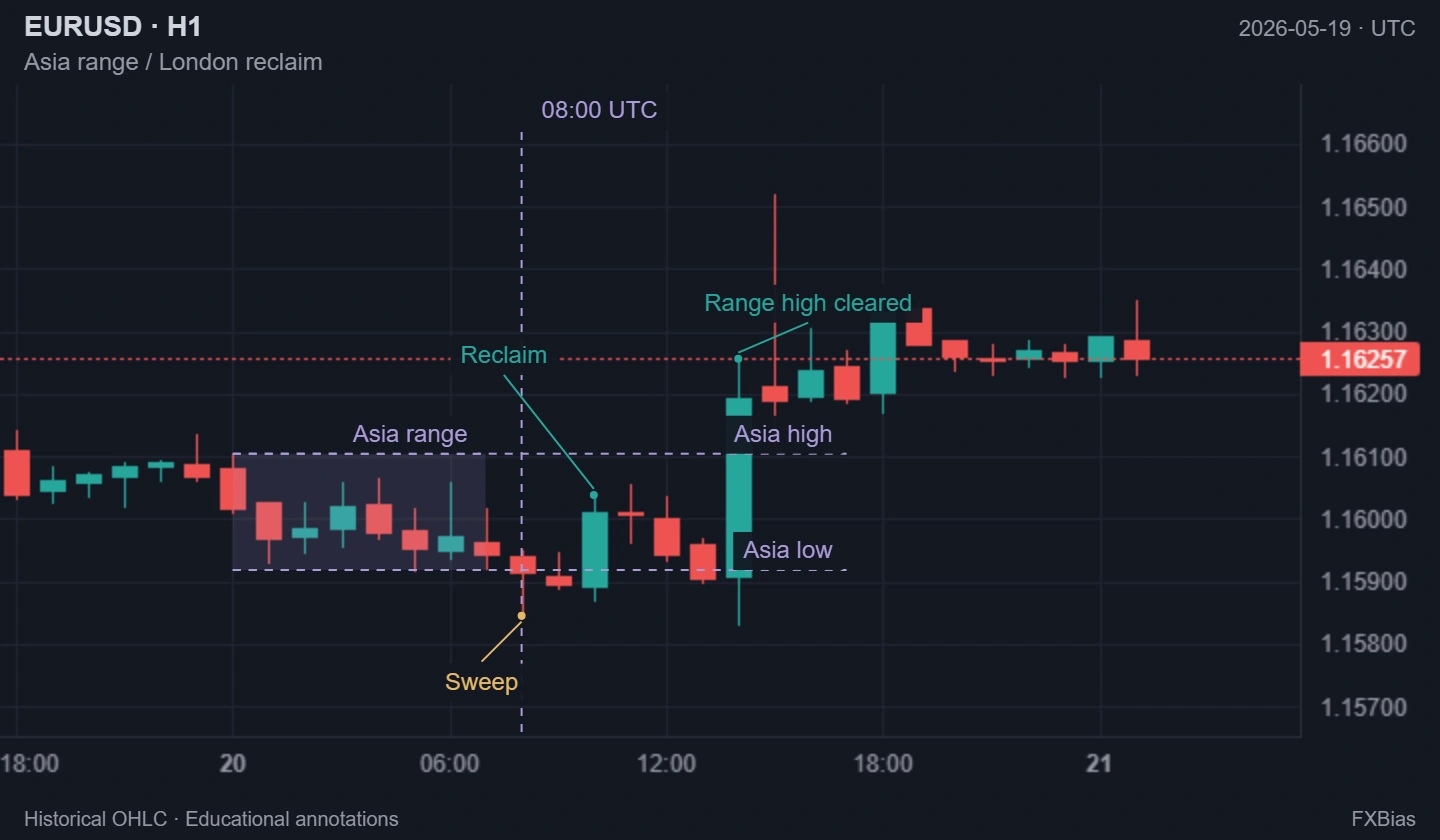 Historical exampleView full size ↗
TradingView Lightweight Charts™ © 2025 TradingView, Inc.
Trading Yen pairs during Asia
USDJPY, AUDJPY and GBPJPY can produce full-session moves during Asia, especially on BoJ days. The setup changes: instead of waiting for a range, trade the breakout from the first hour's consolidation in the direction of the daily bias. Stops should be 2–3× wider than on Euro or Pound pairs — Yen pair volatility is structurally higher.
What to avoid
- Trading Asia as if it were London. The range is smaller; targets must be smaller too.
- Holding Asia trades through London open. Volatility explodes at the London open and will run any stop that is not well-placed.
- Ignoring news. BoJ, RBA, and Chinese data can flip Yen pairs instantly. Check the calendar before placing any Asia trade.
Get the Asia bias before it opens
FXBias publishes the Asia briefing at 23:30 UTC every weekday and, on Sundays, 30 minutes after the weekly reopen (21:30 UTC (US summer time) / 22:30 UTC (winter)) so it can read the weekend gap — always before the session opens. Free users follow up to five pairs; Pro unlocks all fifteen plus the full scenario levels.
Frequently asked
What time is the Asia forex session?
00:00–09:00 UTC, opening with Tokyo at 00:00 UTC. On Sundays the week itself reopens earlier, at 17:00 New York time — 21:00 UTC (US summer time) / 22:00 UTC (winter) — which is when the weekly gap forms. Sydney and Singapore also trade during this window.
Which pairs are best for the Asia session?
Yen pairs lead: USDJPY, AUDJPY, GBPJPY. AUDUSD and NZDUSD also see action on Australian and Chinese data. EURUSD and GBPUSD are usually range-bound until London opens.
Why does London often sweep the Asia range?
London needs counterparty liquidity to position for the day. The Asia range high and low are obvious stop pools. Sweeping one of them in the first hour of London is one of the most repeatable patterns in forex.
Continue reading
Apply this with FXBias daily briefings
Start Free