What is an Order Block in Forex?
6 min read · Updated Jul 28, 2026
Short answer
An order block is the last opposing candle before an impulsive move away from a level — the last down candle before a rally, or the last up candle before a sell-off. It marks where institutional orders were filled, and price frequently returns to that zone later and reacts from it.
An order block is the last opposing candle before an impulsive move away from a level. Before a strong rally, it is the last down candle; before a sharp sell-off, the last up candle. The logic is simple: an institution that wants to buy heavily cannot do it all at market, so it accumulates while price is still falling. The candle where that accumulation finished is the footprint it leaves behind.
When price later returns to that zone, the remaining unfilled orders — plus traders defending the position — often produce a reaction. That is why order blocks are used as entry zones rather than as signals on their own.
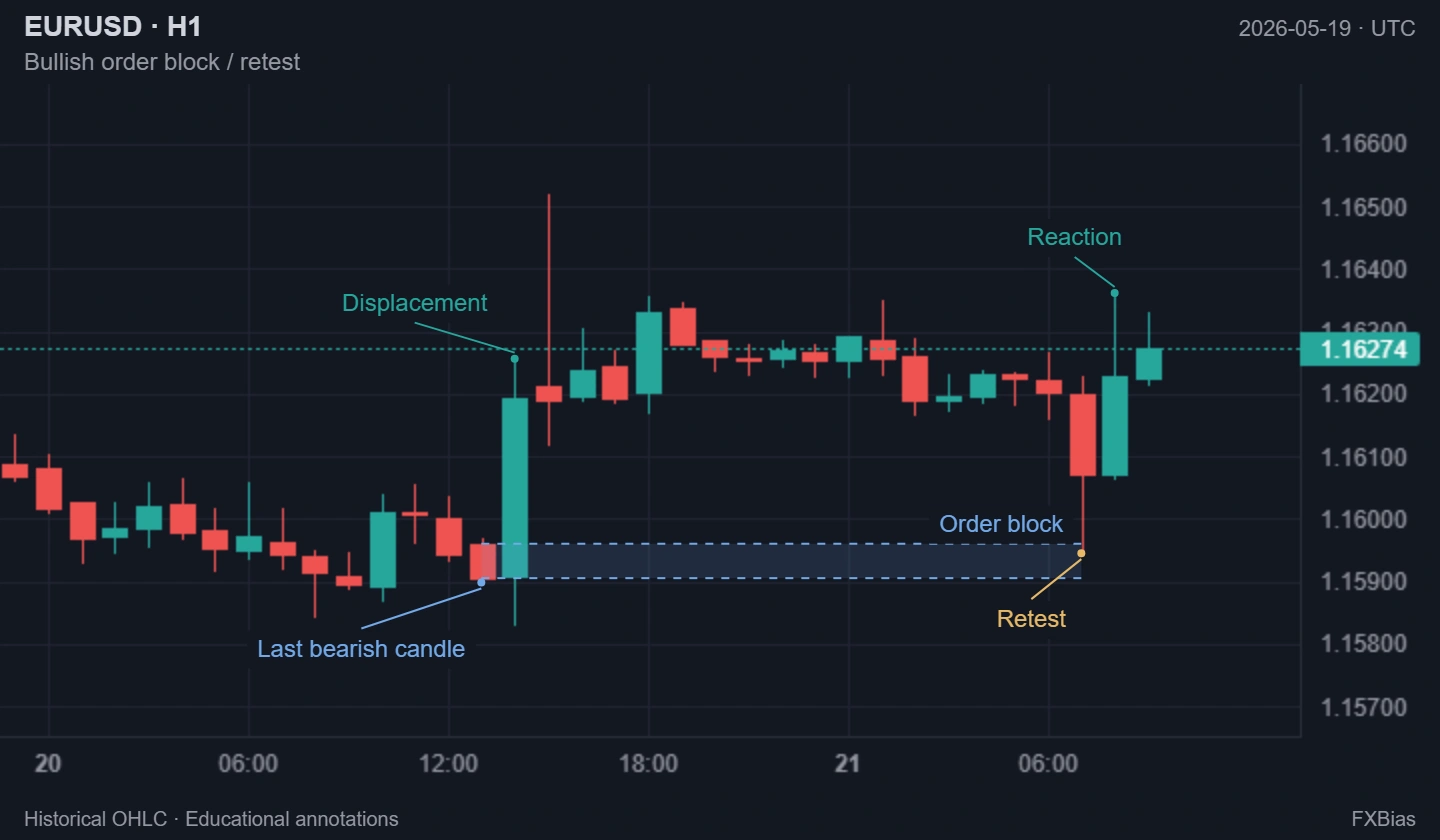 Historical exampleView full size ↗
TradingView Lightweight Charts™ © 2025 TradingView, Inc.
How to mark an order block
- Find the impulse. Look for a move that leaves the area quickly and decisively — not a slow drift.
- Confirm it broke structure. The move should take out a prior swing high or low. An impulse that fails to break structure leaves a much weaker zone.
- Step back one candle. The last candle of the opposite colour before the impulse is your block.
- Draw the zone. Use the candle body as the conservative zone; extend it forward in time until price returns.
Bullish vs bearish order blocks
A bullish order block is the last down candle before a rally — a demand zone you would look to buy from. A bearish order block is the last up candle before a decline — a supply zone you would look to sell from. The mechanic is identical, only the direction changes.
Order blocks vs Fair Value Gaps
These get confused constantly, so it is worth being precise. The order block is where the move started. A Fair Value Gap is the imbalance left in the middle of that same move, where price travelled so fast that no trading occurred at those levels. They frequently sit near each other, and a zone that contains both an order block and an unfilled FVG is a stronger area than either on its own.
Why some order blocks fail
A zone is only as good as the move that created it. The most common mistakes are marking a block from an impulse that never broke structure, using a low timeframe zone against a strong higher timeframe trend, and expecting a reaction on the third or fourth retest when the resting orders have already been consumed. The first retest is usually the cleanest.
Order blocks also work best with context rather than in isolation. Combining a zone with a liquidity sweep just beneath it — where stops are taken before price reverses into your direction — is a considerably higher quality setup than a zone on its own. That context is what a daily bias provides.
Applying it in practice
Mark higher timeframe zones first (H4 and daily), then wait for price to reach one during an active session. FXBias briefings identify these zones automatically across EURUSD, XAUUSD and thirteen other instruments before each session opens, so the levels are ready before the move rather than after it.
Frequently asked
How do you identify a valid order block?
Find an impulsive move that breaks structure, then step back to the last candle of the opposite colour before that move began. That candle's body (some traders use the full high-to-low range) is the order block. If the move that followed did not break structure, the zone is far weaker.
What is the difference between an order block and a Fair Value Gap?
An order block is the candle where the move originated; a Fair Value Gap is the imbalance left behind in the middle of the move. They often sit close together, and a zone containing both is stronger than either alone.
Do order blocks expire?
In practice yes. The more times price returns to a zone, the more of the resting orders are consumed, so the first retest is generally the cleanest. An order block that price closes decisively through has been invalidated.
Which timeframe order blocks are most reliable?
Higher timeframes hold better because they represent larger positions. A 4-hour or daily order block is far more significant than a 5-minute one, which is why many traders mark zones on H4 and then look for entries on lower timeframes.
Continue reading
Apply this with FXBias daily briefings
Start Free