How to Trade the New York Session
7 min read · Updated Sep 11, 2026
Short answer
The New York session runs 13:00–22:00 UTC in winter (12:00–21:00 UTC on US daylight time) and splits into two very different halves. Its first four hours overlap with London and carry the deepest liquidity of the day, with most US economic data released at 8:30 New York time (13:30 UTC in winter, 12:30 in summer). After London closes, participation falls sharply and the remaining hours are usually slow drift or partial retracement.
The New York session covers 13:00–22:00 UTC in winter, and treating it as one continuous block is the most common way to misread it. It is really two sessions with different liquidity, different volatility and different sensible trade sizes.
A note on the clock: every UTC time in this article is the winter one. While the United States is on daylight time — mid-March to early November — each of them lands an hour earlier in UTC (the session itself runs 12:00–21:00 UTC), and London shifts on its own dates, late March and late October, so for a few weeks each spring and autumn the overlap runs an hour longer or shorter.
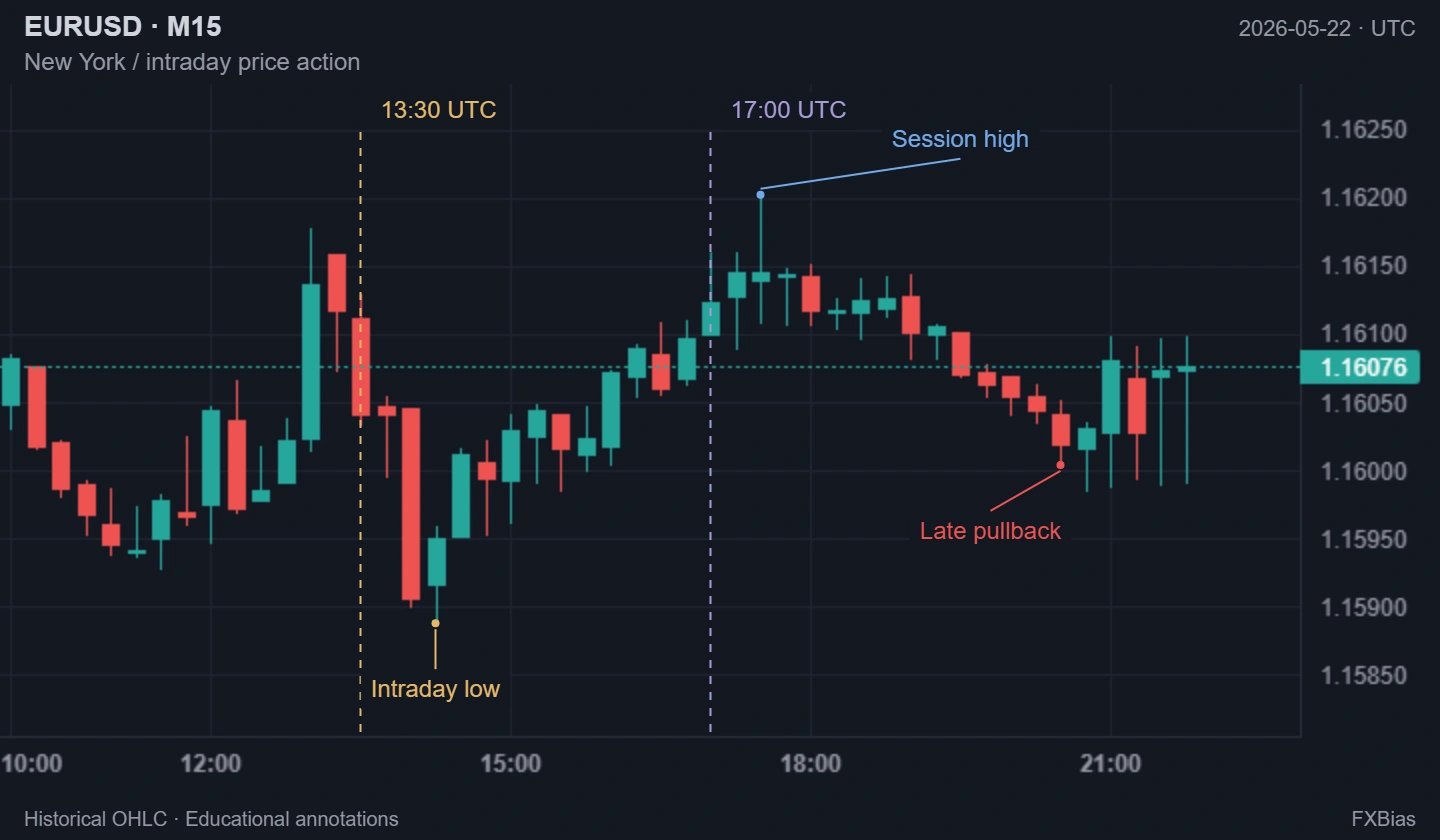 Historical exampleView full size ↗
TradingView Lightweight Charts™ © 2025 TradingView, Inc.
The first half: the London overlap
Between 13:00 and 17:00 UTC, New York and London are open simultaneously. This is the deepest liquidity window of the entire trading day — the moment when the largest positions can be moved with the least slippage, and when spreads on the majors are at their tightest.
It is also when the US calendar fires. The 13:30 UTC slot carries non-farm payrolls, CPI, retail sales and weekly jobless claims; 15:00 UTC adds ISM surveys, JOLTS and consumer confidence. On FOMC days the rate decision lands at 19:00 UTC with the press conference half an hour later, which is the one scheduled event that falls outside the overlap and still moves the market violently.
What a data release actually does
The first seconds after a release are not a tradable read on anything. Spreads widen, fills slip, and price frequently probes both directions before settling. What is useful is the structure left behind once the initial reaction resolves: the extremes printed in those minutes become reference levels for the rest of the session, and the gaps torn open by the move are textbook Fair Value Gaps that price often revisits later in the afternoon.
A second pattern worth knowing: the initial reaction to a release is frequently reversed within the hour as the market digests the detail behind the headline number. A payrolls print that looks strong on the headline but weak underneath can move in one direction on release and the other once the revisions are read.
The second half: after the London close
At 17:00 UTC London closes, and roughly half the day's participants leave. Ranges compress, trends that ran through the afternoon often give back part of their move, and by 20:00 UTC most instruments are drifting in a few pips.
This has a direct consequence for anything opened earlier: the market a trade is closed in is not the market it was opened in. A position sized for the overlap is sized for conditions that no longer exist at 19:00 UTC. The thinner book also means that the occasional headline landing in these hours moves price further than the same headline would have moved it at 14:00.
The 17:00 New York close
For most brokers, 17:00 New York time (21:00 UTC (US summer time) / 22:00 UTC (winter)) is where the daily candle closes and rolls over — the daily open, high, low and close that every higher-timeframe analysis depends on are cut at this point. It is also when swap is charged or credited, and when spreads widen briefly during the rollover. It is a poor time to open anything and a common time to be stopped out of something by a spread spike rather than a real move.
Common mistakes
- Trading the release itself. Entering in the seconds around 13:30 UTC is a bet on slippage as much as on direction. The structure left behind is more useful than the spike.
- Carrying overlap-sized positions into the evening. The same size behaves differently once half the market has gone home.
- Reading the post-17:00 drift as a trend. A slow grind on thin volume is not the same signal as a directional move on a full book, even when the chart looks identical.
- Forgetting the rollover. Spreads widen around the 17:00 New York rollover (21:00 UTC (US summer time) / 22:00 UTC (winter)). Stops sitting close to price can be taken out by the spread alone.
Frequently asked
What time is the New York forex session?
13:00–22:00 UTC, matching an 8am–5pm working day in New York during the winter months. The United States observes daylight saving from mid-March to early November, which shifts the same local day one hour earlier in UTC terms. The US and UK clock changes fall on different dates, so the London overlap briefly stretches or shrinks twice a year.
When is the best time to trade the New York session?
The four-hour overlap with London — 13:00–17:00 UTC in winter, 12:00–16:00 UTC when both centres are on summer time — when both regions are trading the same instruments. Liquidity is at its deepest, spreads at their tightest and the scheduled US data lands inside this window. After the London close the character of the session changes completely.
Why does price often reverse after the London close?
European desks square their positions into the London close (17:00 UTC in winter, 16:00 in summer) and then step away. The order flow that carried the afternoon move disappears, so the move frequently stalls and gives back part of its range on much lower volume. It is a liquidity effect rather than a change in conviction, which is why the retracement often fails to reach any meaningful level.
Which pairs are most active during the New York session?
The dollar majors — EURUSD, GBPUSD, USDJPY — plus gold, which is priced in dollars and reacts directly to US data. USDCAD deserves particular attention because Canadian releases often share the 8:30 New York slot (13:30 UTC in winter, 12:30 in summer) with US ones, putting both sides of the pair in play at the same moment.
Continue reading
Apply this with FXBias daily briefings
Start Free