Smart Money Concepts: A Trader's Guide
7 min read · Updated May 23, 2026
Short answer
Smart Money Concepts (SMC) is a price-action framework built on the idea that institutional orders need resting liquidity to fill. It reads charts through market structure (breaks of structure and changes of character), liquidity pools above highs and below lows, and imbalances such as Fair Value Gaps and order blocks — rather than through lagging indicators.
Smart Money Concepts (SMC) is a price-action framework that interprets every chart through the lens of institutional behaviour. Where traditional technical analysis sees support and resistance, SMC sees liquidity pools. Where indicators see overbought conditions, SMC looks for order blocks and Fair Value Gaps. The framework gives a coherent story for why price does what it does — and a repeatable playbook for trading it.
The three pillars of SMC
1. Liquidity
Every chart has obvious places where stop-loss orders pile up: above swing highs, below swing lows, around equal highs/lows. These pools are targeted by institutions to fill large positions. SMC asks one question before any entry: where is the liquidity, and has it been taken yet?
2. Market structure
Price moves in legs. A bullish structure prints higher highs and higher lows; bearish is the opposite. The key moment is the Break of Structure (BOS) — a higher high in a bullish trend confirms continuation. The bigger moment is the Change of Character(ChoCh) — the first lower low after a bullish trend, which signals a possible reversal. Bias flips on ChoCh, not on BOS.
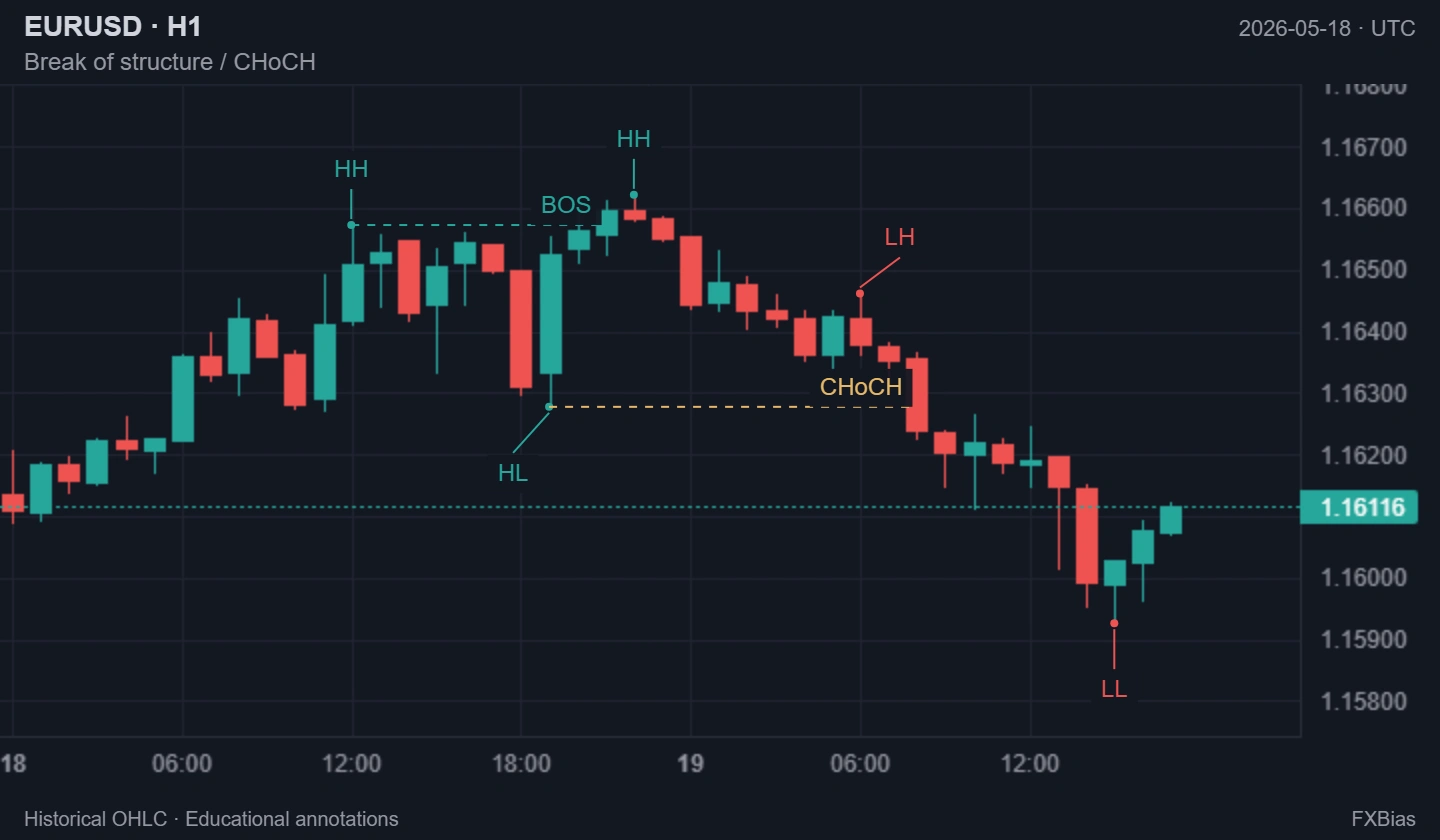 Historical exampleView full size ↗
TradingView Lightweight Charts™ © 2025 TradingView, Inc.
3. Imbalance and order blocks
Fair Value Gaps mark where price moved too fast. Order blocks mark where the last opposing candle printed before the impulsive move — institutions left an order there. Both act as future support/resistance zones where price often returns before continuing.
The SMC playbook
The textbook SMC trade has four steps:
- HTF bias. On the H4 or daily, identify whether structure is bullish or bearish.
- Liquidity sweep. Wait for price to take out a meaningful pool of stops on the LTF (M15 or H1).
- Change of character. Confirm the sweep with a structure shift on the LTF — a lower low after a high (for shorts) or a higher high after a low (for longs).
- FVG or order block entry. Enter on the retrace into the freshly created imbalance, stop beyond the swept liquidity, target the next opposing liquidity pool.
Where SMC fits in a daily routine
SMC works best when layered onto a session-based routine:
- Pre-London: mark Asia range high/low — these are the first liquidity targets.
- London open: watch for a sweep of Asia range; trade the reversal in the bias direction.
- Pre-New York: mark London H/L; expect a sweep on the NY open.
- NY afternoon: trends mature, FVGs from earlier sessions get filled.
SMC is not magic
Plenty of sweeps continue rather than reverse. Plenty of FVGs never get filled. The framework is a probability tilt, not a certainty. Three rules keep traders honest:
- Always trade with HTF bias. Counter-trend SMC setups are a coin flip; with-trend setups have edge.
- Wait for confirmation. Sweep alone is not a signal. Sweep + ChoCh + FVG is.
- Risk fixed R per trade. The edge is small per setup and accumulates over many trades.
Further reading
Continue with how to build a daily bias and trading the Asia session to put the framework into practice.
Frequently asked
What are Smart Money Concepts?
A price-action framework that interprets charts through the lens of institutional behaviour. Core ideas include liquidity pools, order blocks, Fair Value Gaps, and market structure shifts.
Is SMC the same as ICT?
ICT (Inner Circle Trader) is one popularised version of SMC concepts. The underlying ideas — institutions need liquidity, price returns to inefficiencies — predate ICT and appear across many discretionary trading schools.
Does SMC work in forex?
Yes, especially in the most liquid pairs (EURUSD, GBPUSD, USDJPY, XAUUSD) where institutional flow is highest. Lower-liquidity exotics are noisier and less reliable for SMC patterns.
Continue reading
Apply this with FXBias daily briefings
Start Free